Concept, words and sketches by Lori Muñoz · Illustrated by Ivano Nardacchione · An original series by BrokersOfGood.
From the creator
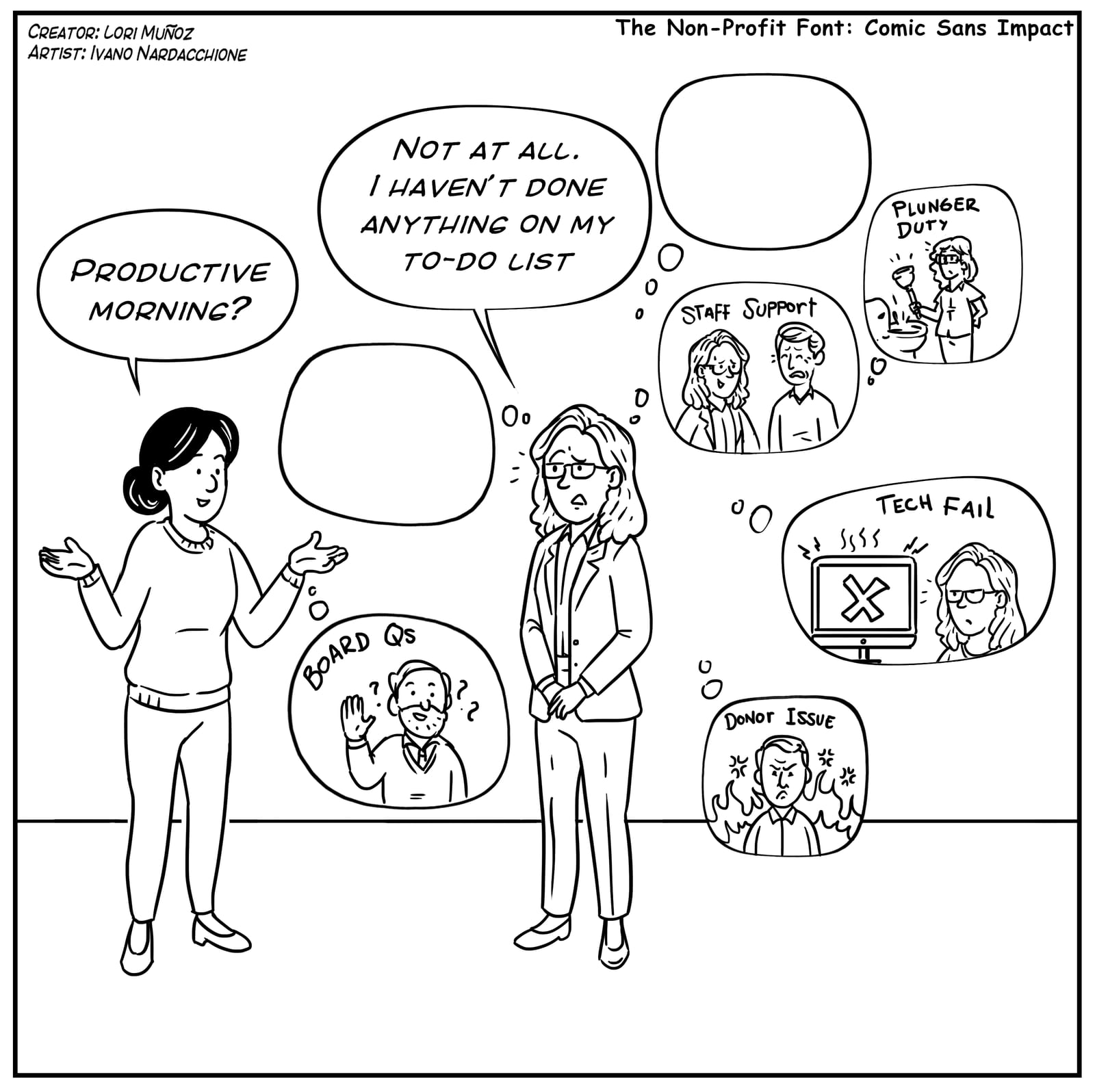
The to-do list says one thing. The workday has other plans.
Mondays. What’s missing from this list?
We’re asking nonprofit leaders and their teams to tackle some of society’s biggest challenges, deliver meaningful impact and move ambitious missions forward.
But we’re also asking them to do it without the resources to support the work.
In smaller organizations especially, there often isn’t an IT department, an HR team, a facilities person or an operations manager. Those responsibilities don’t disappear. They just get added to someone’s already full plate.
So the person who’s supposed to be building partnerships is also troubleshooting the printer. The executive director who’s meant to be thinking strategically is dealing with a plumbing problem. The program lead is answering donor questions, sorting out a technology failure and covering for an absent colleague.
Everyone has a primary job. And then there’s everything else.
These aren’t necessarily small tasks. They’re small tasks that accumulate, interrupt, consume time and pull people away from the work they’re actually expected to deliver.
And that’s the irony: we’re measuring people against the big goals while weighing them down with all the little things that come with not having enough people, capacity or infrastructure.
We’re asking people to do more with less, then wondering why the big things aren’t getting done.
The list may look untouched. The work certainly wasn’t.
Questions to consider
How much of your team’s time is spent on work outside their actual roles because there simply isn’t anyone else to do it?
What important work gets pushed aside to make room for the operational demands of keeping the organization running?
Are we setting ambitious expectations without providing the people, resources and infrastructure needed to meet them?
What would your team be able to accomplish if they weren’t constantly filling the gaps?
When we talk about organizational capacity, are we counting all the work people are already doing — including the work nobody sees?

From the creator
The to-do list says one thing. The workday has other plans.
Mondays. What’s missing from this list?
We’re asking nonprofit leaders and their teams to tackle some of society’s biggest challenges, deliver meaningful impact and move ambitious missions forward.
But we’re also asking them to do it without the resources to support the work.
In smaller organizations especially, there often isn’t an IT department, an HR team, a facilities person or an operations manager. Those responsibilities don’t disappear. They just get added to someone’s already full plate.
So the person who’s supposed to be building partnerships is also troubleshooting the printer. The executive director who’s meant to be thinking strategically is dealing with a plumbing problem. The program lead is answering donor questions, sorting out a technology failure and covering for an absent colleague.
Everyone has a primary job. And then there’s everything else.
These aren’t necessarily small tasks. They’re small tasks that accumulate, interrupt, consume time and pull people away from the work they’re actually expected to deliver.
And that’s the irony: we’re measuring people against the big goals while weighing them down with all the little things that come with not having enough people, capacity or infrastructure.
We’re asking people to do more with less, then wondering why the big things aren’t getting done.
The list may look untouched. The work certainly wasn’t.
Questions to consider